
Leadership is often described through skills, frameworks, and methods, but when you look closely at leaders who truly make an impact, something deeper becomes visible. It is not only about what they can do, but about how they think, how they behave, and how consistently they show up in everyday situations.
In a world shaped by constant change and increasingly influenced by AI, this distinction becomes even more important. Tools can support execution and speed up decision making, but they cannot replace the human qualities that build trust, create direction, and hold teams together.
Leadership starts with character
It is easy to focus on outcomes such as delivery, performance, or growth, but behind every result there is a chain of decisions and behaviors that reflect the leader’s mindset.
Good leadership is not built on isolated actions. It is built on patterns that repeat over time.
People rarely follow leaders because of their title alone. They follow them because they trust their judgment, their intentions, and the way they handle both success and failure. That trust is shaped by qualities that become most visible in moments of uncertainty, pressure, or conflict.
Why qualities and skills are now deeply connected
As technology evolves, the gap between having knowledge and applying it effectively is becoming more visible. AI can generate ideas, suggest solutions, and support execution, but it still depends on human judgment to decide what actually makes sense in a given context.
This is where leadership qualities and leadership skills begin to overlap.
For example, communication is not only a skill - it reflects clarity and respect for others.
Emotional intelligence is not only a capability - it is rooted in empathy.
The strongest leaders are those who combine both dimensions: they develop skills, but those skills are grounded in consistent personal qualities.
The qualities of a good leader, supported by real skills
Instead of treating qualities and skills as separate areas, it is more useful to see how they reinforce each other in practice:
1. Clarity supported by communication
A good leader brings clarity, especially in complex or uncertain situations. This quality becomes real through strong communication.
Leaders who communicate well are able to simplify complexity without losing meaning. They align teams around shared goals and ensure that expectations are understood, not just stated. Over time, this reduces confusion and helps teams move faster with more confidence.
A simple example is a situation where a project starts drifting because everyone has a slightly different understanding of priorities. A strong leader pauses the work, gathers the team, and clearly explains what matters most right now and what can wait. Within one meeting, the team regains focus.
2. Empathy expressed through emotional intelligence
Empathy allows leaders to understand people beyond surface level interactions. Emotional intelligence is how that understanding is applied in real situations.
Leaders who combine both can read the room, adjust their approach depending on the person, and navigate tension without creating unnecessary conflict. This leads to stronger relationships and a higher level of trust across the team.
For example, when a developer suddenly starts missing deadlines, an average reaction might be pressure or escalation. A leader with empathy takes time to talk and discovers the person is overwhelmed or dealing with something personal. Instead of pushing harder, they adjust workload and support them, which often leads to better long term performance.
3. Responsibility strengthened by ownership
Responsibility is a core leadership quality, but it only becomes visible through ownership.
Leaders who take ownership do not shift blame or avoid difficult situations. Instead, they take accountability for outcomes and create an environment where others feel encouraged to do the same. This builds a culture where people focus on solutions rather than excuses.
A typical situation is a failed release. Instead of saying the team made mistakes, a strong leader communicates to stakeholders that the responsibility sits with them, then works internally with the team to understand what happened and improve the process.
4. Curiosity developed through critical thinking
Curiosity drives leaders to explore, question, and understand, while critical thinking allows them to evaluate what they discover.
In practice, this means not accepting information at face value, especially in a world where AI can generate convincing but imperfect outputs. Leaders who combine curiosity with critical thinking are better at making thoughtful decisions and avoiding costly assumptions.
For instance, when a report shows a sudden drop in performance, a reactive leader might immediately push for quick fixes. A curious leader asks what changed, questions the data, and looks deeper, often discovering that the issue comes from a measurement error or an external factor.
5. Adaptability as a response to constant change
Adaptability is no longer optional. It is a natural response to an environment where priorities shift and new information appears constantly.
Leaders who are adaptable do not rely on rigid plans. Instead, they stay focused on outcomes while remaining flexible in how they get there. This allows them to guide teams through uncertainty without losing direction.
A common example is a client changing scope mid project. Instead of resisting or forcing the original plan, an adaptable leader reassesses priorities with the team, redefines the approach, and communicates the changes clearly, keeping both progress and morale intact.
6. Commitment to growth through coaching and mentoring
A good leader does not focus only on immediate results. They also invest in long term development of their team.
Coaching and mentoring are how this quality shows up in everyday work. Leaders who take the time to ask the right questions, give meaningful feedback, and support individual growth create stronger and more capable teams over time.
For example, instead of fixing a problem for a junior team member, a leader walks through the situation with them, asks guiding questions, and helps them arrive at the solution on their own. It takes more time in the moment, but builds independence for the future.
7. Courage expressed in decision making
Courage is what allows leaders to act when situations are unclear or uncomfortable.
This often shows up in decision making, where not all information is available and the right choice is not always obvious. Leaders who combine courage with good judgment are able to move forward while taking responsibility for the outcomes, even when the path is uncertain.
A typical example is addressing underperformance in the team. Avoiding the conversation may feel easier, but a courageous leader addresses the issue directly, gives honest feedback, and makes decisions that are better for the team in the long run.
How this shows up in everyday leadership
These qualities and skills are not theoretical concepts. They are visible in daily work, often in small and seemingly simple moments. They appear in how a leader explains priorities, how they respond to mistakes, how they handle difficult conversations, and how they support someone who is struggling. Over time, these moments create a consistent experience for the team.
This is what people remember and what ultimately defines leadership.
Where a competency matrix becomes useful
One of the biggest challenges with leadership development is that qualities can feel abstract, while skills can feel disconnected from real behavior.
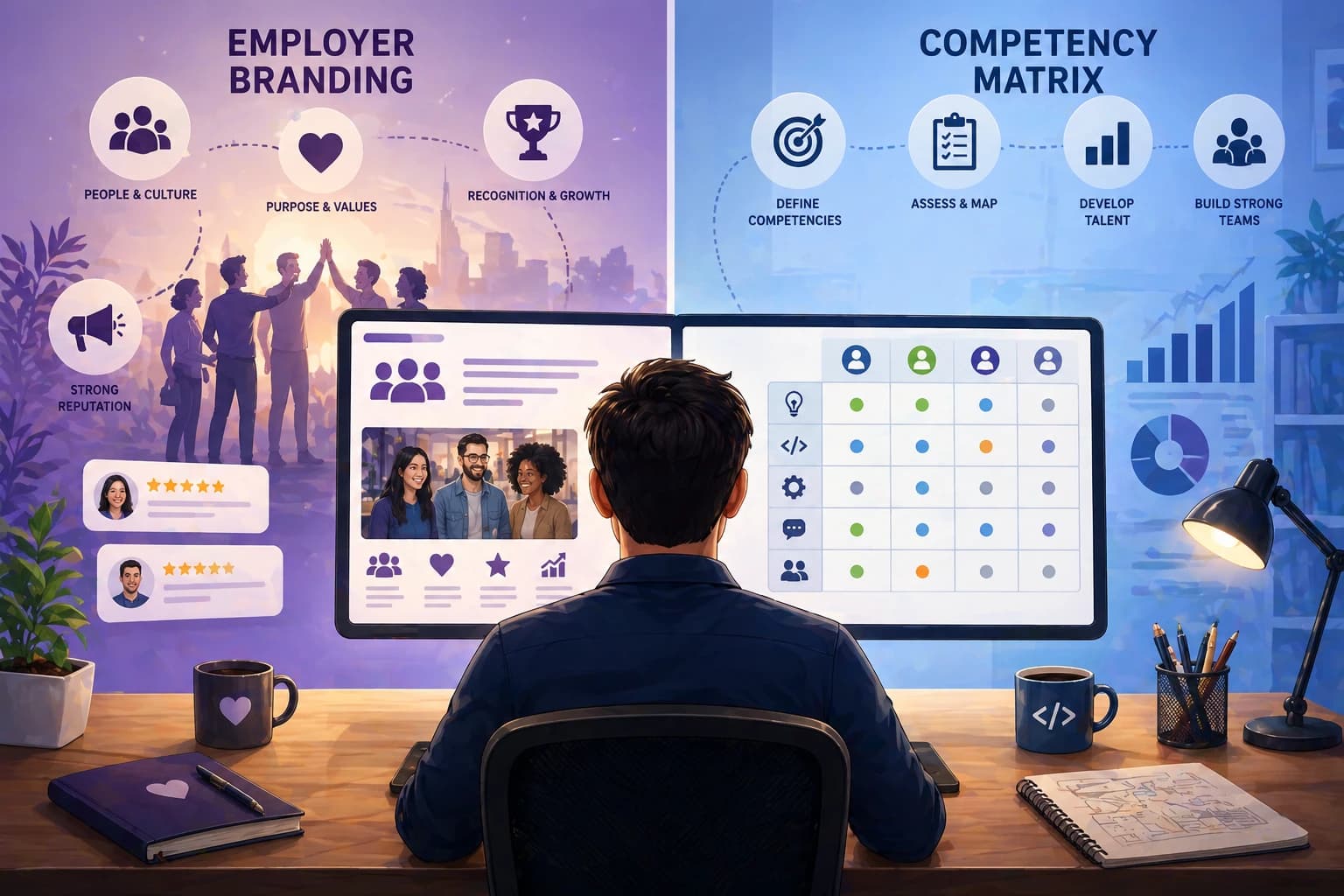
A competency and skills matrix helps bridge this gap.
It allows you to define both qualities and skills in a structured way, translate them into observable behaviors, and describe what different levels of maturity look like. This makes it easier to assess current capabilities and create clear development paths.
Instead of vague feedback, leaders receive specific guidance on what to improve and how to grow.
In the end
There is no perfect combination of qualities that guarantees success in every situation, but there are patterns that consistently lead to stronger leadership.
The most effective leaders are not those who rely only on skills or only on personality. They are the ones who combine both in a way that feels consistent, intentional, and human.
As technology continues to evolve, this balance will only become more important. The tools will keep improving, but it is the human side of leadership that will continue to define how teams perform and grow.
And that is exactly where real leadership begins.