
Skills Matrix Explained
What It Is, How It Works, and How to Use It Effectively
A Skills Matrix is one of the most practical tools for understanding, managing, and developing team capabilities. It helps organizations move away from assumptions and subjective judgments toward clarity, shared expectations, and data informed decisions about people and skills.
Used consistently, a skills matrix improves visibility across teams, supports better evaluations, and enables intentional growth aligned with real business needs.
What Is a Skills Matrix
A Skills Matrix is a structured way of representing skills within a team, department, or organization. From a technical perspective, it is a table composed of rows and columns that map skills to people or roles using defined proficiency levels.
Most commonly:
- Rows represent people or roles
- Columns represent specific skills
- Cells contain a proficiency level or skill rating
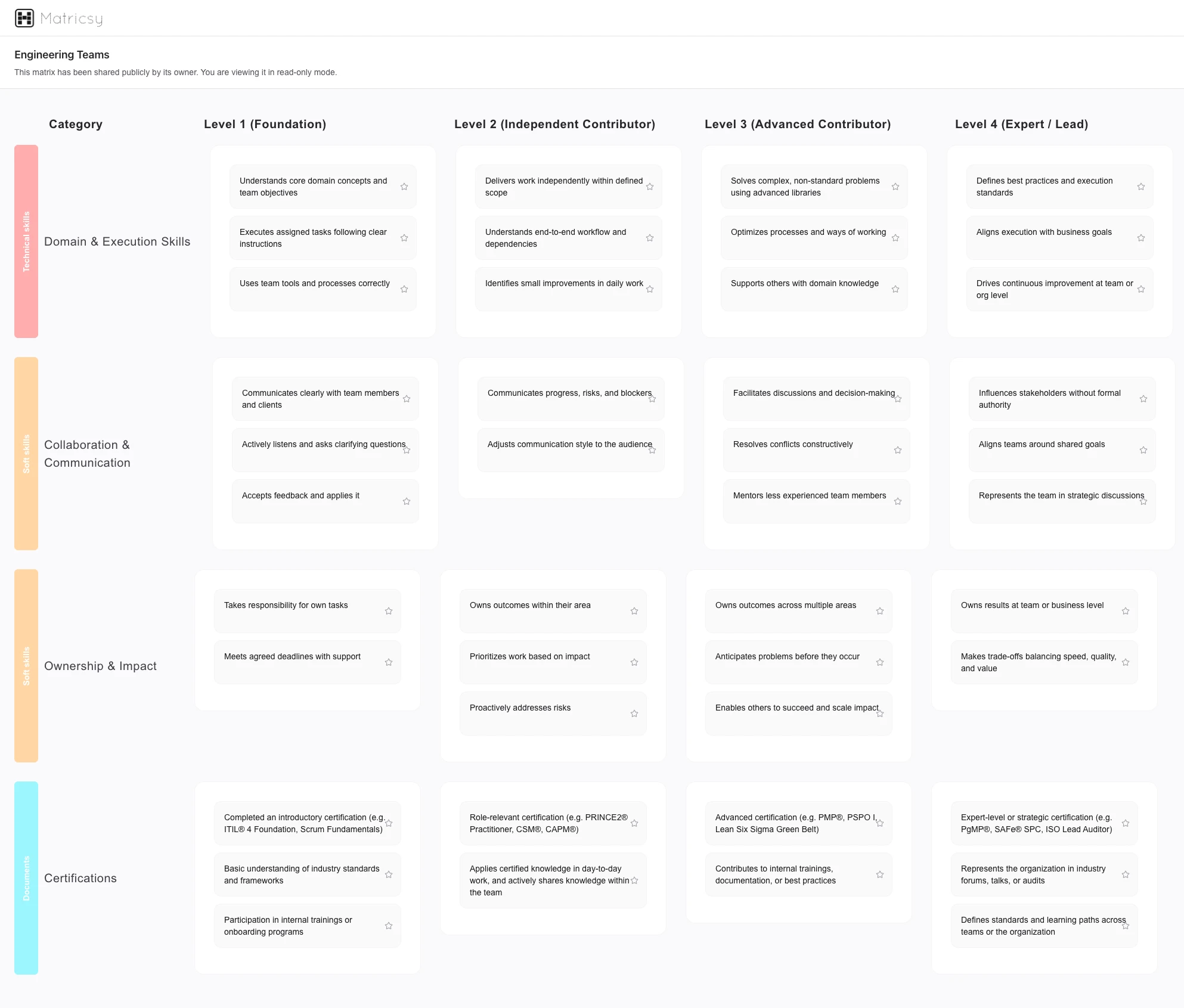
Example of a skills matrix - visual representation of a skills matrix
Each cell answers a simple question: How strong is this person or role in this specific skill?
Despite its simple structure, a skills matrix creates a powerful shared overview. It allows teams to compare capabilities, identify gaps, and track progress in a way that is easy to understand and maintain.
Core Elements of a Skills Matrix
A well designed skills matrix is built from three fundamental components:
Skills
Skills represent concrete and observable capabilities required to perform real work. These can include technical skills, domain knowledge, process related skills, or collaboration skills. What matters most is relevance. A skills matrix should reflect what the team actually needs today and in the near future.
Proficiency Levels
Each skill is described using clearly defined levels. These levels explain what progression looks like and remove ambiguity from assessments. Without explicit definitions, skill ratings become subjective and inconsistent across managers and teams.
People or Roles
Skills can be mapped to individuals or to roles. Mapping skills to people supports development and feedback. Mapping skills to roles helps define expectations, career paths, and hiring needs. Many organizations use both views depending on context.
Skills Matrix vs Competency Matrix
The terms skills matrix and competency matrix are sometimes used interchangeably, but they often describe different scopes.
A Skills Matrix focuses strictly on skills and proficiency levels. It answers questions about what people can do and how well they can do it.
A Competency Matrix is typically broader. In addition to skills, it may include behaviors, ownership, decision making, autonomy, communication style, or leadership expectations.
In this sense, a skills matrix is often a part of a larger competency matrix. Skills describe the what. Competencies expand the view to include how work is done and how responsibility is handled. Many teams start with a skills matrix because it is concrete, easier to define, and immediately useful. Over time, it can naturally evolve into a broader competency framework.
Why a Skills Matrix Matters
As teams grow and become more cross functional, informal knowledge stops scaling. Without a shared view of skills, organizations rely on memory, assumptions, and outdated documents.
This leads to common problems such as:
- Limited visibility into real capabilities
- Inconsistent expectations across similar roles
- Subjective performance evaluations
- Unclear development priorities
- Reactive hiring decisions
A skills matrix introduces structure and a shared language around skills. It makes expectations explicit and enables better conversations at every level of the organization.
How a Skills Matrix Works
While implementations vary, most skills matrices follow a similar process.
Step 1: Identify Relevant Skills
The first step is defining which skills actually matter. These should be directly connected to real work, team responsibilities, and future direction.
Effective skills lists are focused. They avoid generic or overly broad skills that are difficult to assess or act on.
Step 2: Define Skill Levels
Each skill should be described across multiple levels that clearly explain what proficiency looks like in practice.
Levels might reflect increasing independence, complexity, impact, or ability to support others. Clear definitions reduce misunderstanding and ensure that assessments are consistent across teams.
Step 3: Map Skills to People or Roles
Once skills and levels are defined, they are mapped to individuals or roles.
This mapping can be based on self assessment, manager input, or collaborative discussion during one on one meetings. Differences in perception are not a failure. They often highlight areas that need clarification or alignment.
Step 4: Review and Visualize the Data
A skills matrix becomes valuable when it is easy to review and visualize.
Visualization helps teams quickly identify strengths, gaps, and risks. Regular reviews ensure the matrix stays relevant and reflects reality rather than assumptions.
How to Use a Skills Matrix in Practice
A skills matrix supports everyday work across multiple areas, not just HR processes.
Team and Capacity Planning
Managers can use a skills matrix to understand whether the team is equipped to handle current and upcoming work. This supports better task allocation, balanced workloads, and long term planning.
One on One Meetings
One on one conversations often lack structure. A skills matrix provides a shared reference point that makes discussions more concrete.
It helps focus conversations on strengths, priority gaps, progress since the last meeting, and clear next steps.
Performance and Yearly Reviews
Performance reviews are often perceived as subjective and inconsistent.
A skills matrix introduces shared criteria and evidence based evaluations. Feedback becomes easier to explain and easier to accept because expectations are visible and agreed upon.
Employee Development and Growth
Learning is most effective when it is connected to real needs.
A skills matrix links development directly to role expectations and team priorities. Employees gain clarity on what to focus on and why it matters, making growth intentional rather than random.
Hiring and Onboarding
Hiring decisions improve when teams understand which skills are missing internally.
A skills matrix helps define clearer job expectations, hire for real gaps, and onboard new team members faster with targeted learning paths.
Common Mistakes to Avoid
A skills matrix can lose its value if implemented incorrectly.
Common pitfalls include defining too many skills, using vague level descriptions, treating the matrix as a one time exercise, or using it as a judgment tool instead of a development tool.
A skills matrix should support conversations and decisions, not replace human judgment.
A Skills Matrix as a Living System
The most effective skills matrices evolve over time. They adapt to changing goals, new technologies, and feedback from real usage.
When treated as a living system rather than static documentation, a skills matrix becomes part of how teams plan, grow, and make decisions.
Final Thoughts
A Skills Matrix brings clarity to areas where organizations often rely on assumptions. It makes skills visible, expectations explicit, and growth intentional.
When used consistently, it strengthens teams by design and helps organizations align people development with real business needs.